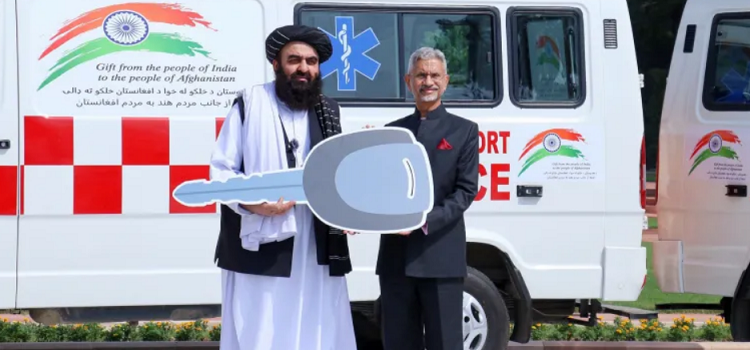
India has taken a historic step to reopen its embassy in Kabul and formally host a Taliban delegation in New Delhi, marking a diplomatic thaw unseen since the regime’s return in 2021. Yet, as trade routes and pragmatic alliances open up, questions of conscience arise. Can India deepen ties with a regime that once marked Hindus with badges, drove Sikhs and Christians into exile, and erased women from public life—without betraying its own democratic ethos?
A Turning Point in New Delhi
In the second week of October 2025, External Affairs Minister S. Jaishankar announced that India would upgrade its technical mission in Kabul to a full embassy, ending four years of minimal presence. (Reuters)
The Taliban’s Foreign Minister, Amir Khan Muttaqi, arrived in India for his first official visit, met senior officials, and signalled that Afghanistan would soon post diplomats in Delhi. (AP News)
India framed the engagement as “technical and humanitarian,” yet the optics are undeniable: a new phase of political normalization between the world’s largest democracy and one of the world’s most repressive regimes.
A Disturbing Echo: The Badges of 2001
In May 2001, the Taliban’s Ministry for the Promotion of Virtue and Prevention of Vice issued a decree requiring Afghan Hindus to wear yellow identifying badges, and to mark their houses for recognition by state authorities. The act drew global outrage for its resemblance to Nazi Germany’s yellow-star policy.
Though the order was never fully enforced due to global pressure, the symbolism was indelible—a government marking its minorities as targets. (BBC Archives)
Two decades later, the few remaining Hindus and Sikhs in Afghanistan live under constant fear, their temples desecrated, and their numbers reduced from tens of thousands to mere dozens.
Women Excluded in Delhi
On October 11, 2025, the Taliban’s foreign minister held a press briefing in New Delhi—and barred all women journalists from entering.Multiple media outlets confirmed the exclusion. India’s Ministry of External Affairs later distanced itself, saying the event was “organized independently.” (Times of India)
Yet this incident unfolded on Indian soil, during a government-facilitated diplomatic visit, sending an unmistakable message: the gender apartheid of Kabul had momentarily arrived in Delhi.
Why Engagement Makes Sense
It is important to recognize why India has chosen this course:
Geopolitical necessity: To counter Pakistan’s influence and regain strategic presence in Afghanistan.
Trade revival: India can reopen key trade routes via Iran’s Chabahar Port, and tap into Afghanistan’s lithium and rare-earth reserves. (Reuters)
Humanitarian access: Millions of Afghans still depend on Indian medical aid, scholarships, and food supplies.
Counterterrorism: Intelligence channels could help neutralize extremist spillovers into Kashmir and Central Asia. Pragmatism is not betrayal. But realpolitik must not erase moral memory.
What Parliament Must Insist On
India’s Parliament and Ministry of External Affairs should embed red lines and moral safeguards into any renewed engagement. These include:
1. Human rights clauses in every trade and aid agreement.
2. Legal and physical protection for Afghan Hindus, Sikhs, Christians, and Hazaras.
3. Unhindered access to girls’ education and women’s employment.
4. Commitment to media access and protection for female journalists.
5. Public accountability: The MEA must publish quarterly reports on the situation of minorities in Afghanistan.
Engagement without conditions risks legitimising the Taliban’s ideological apartheid—against both gender and faith.
Signs of Possible Reform?
There are modest, tentative signals that engagement might yield limited moderation. Some Taliban representatives privately told Indian officials they would welcome Hindu and Sikh community leaders back to Kabul, under security guarantees. (Times of India)
Economic desperation may also push the Taliban to seek legitimacy through small gestures—reopening girls’ schools in select provinces, granting minorities symbolic representation in local councils, or easing restrictions on women-run NGOs.
However, unless these promises are codified, verified, and publicly reported, they remain propaganda, not progress.
India’s Moral Test
The real question before Parliament is not whether India should talk to the Taliban—it is whether India can talk to them without forgetting who they are and what they did.
The Taliban once made Hindus wear armbands, destroyed Buddhist heritage, expelled Sikhs, silenced Christians, and erased women from civic life.
If New Delhi now reopens its embassy while remaining silent on these crimes, it risks turning India’s tricolour diplomacy into moral grayscale.
India can be both pragmatic and principled—building trade and dialogue while standing firm for human rights and dignity. That, indeed, would be the legacy worthy of a civilisation whose own dharmic ethos teaches:
“Ahimsa paramo dharmaḥ — Non-violence and truth are the highest duties.”
References
1. Reuters – India to reopen its embassy in Kabul (https://www.reuters.com/world/india/india-reopen-its-embassy-kabul-indian-foreign-minister-says-2025-10-10/?utm_source=chatgpt.com)
2. AP News – India to upgrade Kabul mission (https://apnews.com/article/899bac27dee2422e88a54372bdd9efaa?utm_source=chatgpt.com)
3. Times of India – Women journalists barred from Taliban presser (https://timesofindia.indiatimes.com/india/women-journalists-barred-taliban-presser-in-new-delhi-restricts-entry-of-females-draws-ire/articleshow/124468538.cms?utm_source=chatgpt.com)
4. BBC Archives – Taliban orders Hindus to wear badges (https://news.bbc.co.uk/2/hi/south_asia/1340571.stm?utm_source=chatgpt.com)
5. Human Rights Watch – Afghanistan country report 2025 (https://www.hrw.org/world-report/2025/country-chapters/afghanistan?utm_source=chatgpt.com)