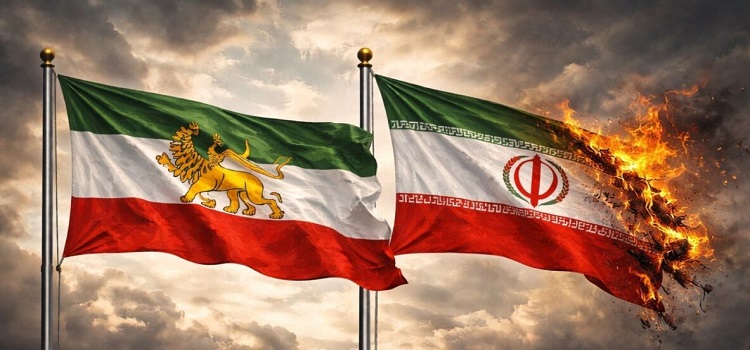
India today faces a contradiction that is becoming harder to ignore. A civilisation rooted in pluralism, resilience, and Dharmic balance is, in parts, drifting toward sympathy for Adharmic forces that historically and presently stand in opposition to those very principles. The issue is not Iran as a civilisation. It is the ideological and military apparatus represented by the IRGC.
A Reality Check: Indian Interests Under Direct Threat
Recent incidents in the Strait of Hormuz have made one fact unmistakably clear. Indian-linked vessels have faced hostile actions in a highly strategic maritime corridor. Passage through a global trade artery is being treated as conditional, subject to approval by armed actors. Regional instability is directly impacting India’s energy security and trade routes. This is not abstract geopolitics. It is pressure applied in real time. Alongside this, a troubling social pattern is emerging where Individuals publicly expressing admiration for the Iranian state power structures, along with financial contributions or symbolic support, are being amplified on social media by not only Islamists but also Hindus, along with the Hindutva crew, with Narratives framed as “anti-Western resistance” being adopted without scrutiny.
This creates a dangerous disconnect between perception and reality. Supporting any external force without examining its stance toward ‘Hindu’ India is not informed activism. It is a blind misalignment.
Kashmir: External Narratives, Internal Consequences
Iran’s ideological influence, particularly post-1979, has had resonance in segments of Kashmir. The concern is not religious affinity alone, but political narrative shaping, where Kashmir is framed as a site of resistance rather than an integral part of India, giving an external validation of Islamic separatist sentiment, while marginalising the indigenous Kashmiri Hindus, a community already genocided and displaced in large numbers. This reinforces a long-standing injustice.
The IRGC Model: Power Through Suppression
Any serious evaluation of the IRGC must consider its operational pattern, with its strong internal control over dissent, and with severe crackdowns on protest movements, especially against the mullah regime rooted in arab colonisation and its export of ideological narratives beyond national borders. Reports over recent years have documented large-scale suppression of protesters, restrictions on civil liberties, and a tightly controlled political environment, with a direct Contradiction to the Dharma ethos. From a Hindu human rights lens, the most critical issue is religious freedom. Baháʼís face systemic discrimination, including denial of education and economic participation. Zoroastrians, inheritors of ancient Persian spiritual traditions, exist today as a small and constrained minority. India has historically offered refuge to Zoroastrians fleeing persecution, helping preserve Iran’s ancient Persian culture. That legacy stands in contrast to any silence on their condition in their homeland.
Ancient Persia: What History Actually Teaches.
The Muslim conquest of Persia led to the fall of the Sasanian Empire. Over time, Zoroastrian institutions declined significantly as new political and religious structures took hold. This was a profound civilisational transformation.
The Indian Subcontinent With Its Hindu Resistance.
The subcontinent also faced multiple waves of incursions and state formations under Islamic rule, beginning with the Umayyad conquest of Sindh. However, the trajectory in India was not uniform:
Powerful Hindu polities such as the Gurjara-Pratihara resistance, the Chalukya dynasty resistance, and, later, the Maratha Empire’s expansion through warrior resistance inspired by Hinduism. Large parts of the subcontinent retained their Hindu civilisational continuity, languages, and traditions. Even under adverse conditions, indigenous systems adapted and survived. The takeaway is not triumphalism. It is resilience. India was not untouched. But it was not erased.
India’s Strategic and Moral Imperative
India needs to question the Iranian representatives on human rights, including the treatment of protesters and minorities and its external influence on Kashmir.
The Dharmic Lens is not about alignment based on convenience. It is about alignment based on truth and balance. Ignoring persecution while praising power structures creates a moral contradiction by romanticising external forces without examining their actions, which leads to strategic error, which is Adharmic. Which is why it’s Bharat’s duty to help revive Persia’s ancient civilisation because both share a deep civilisational connection. That should be preserved and respected.