The decline of Christianity as our unifying religion has seen modern society finding faith in a much older world
“Paganism” is a word with which to conjure. From The Iliad to the Wicker Man, it has been part of Western culture, and has in recent times come to mean everything from an esoteric worldview to being the secret symbology of the far Right.
But scrape away the myths and projections, and modern Paganism is revealed as a serious, significant religious position within British society – and one that is particularly fast-growing. The census tells us that there has been a near 30 per cent increase in adherents since 2011 (from an admittedly low base), and yesterday a report from the Institute for the Impact of Faith in Life revealed that Paganism is the most popular spiritual destination for people dropping out of Christianity.
The broad context for this is clear enough: the decline of Christianity as the dominant and unifying kind of religion for the British; the creation of a more pluralistic society, multi-ethnic, multi-cultural and (therefore) multi-faith; and the loss of the appeal of established religions in favour of those which can be carried on in small community-based units, or even in living rooms and back gardens. Paganism fits right in here, but why is it so especially appealing?
To answer this it is best to start by explaining what Paganism is. Put simply, it is an umbrella term for a complex of recently-appeared religions that are all inspired by the images and ideas of the pre-Christian religious traditions of Europe and the Near East. These would include the Olympian deities of ancient Greece and Rome, Odin or Woden and his fellows from the Norse and Germanic worlds, and Celtic, Egyptian or Mesopotamian divine figures.
In addition to such specifically, historically attested divinities, there are more abstract archetypes generated from them by modern literature: the horned or antlered god personifying wild nature, the moon goddess whose three phases represent those of womanhood, and so forth.

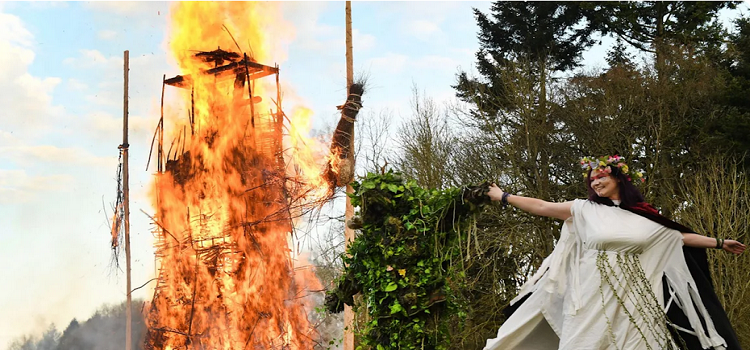
Pagans today generally do not have designated temples or shrines but – following traditions of ritual magic – consecrate a space anew for each ceremony, in a range of chosen locations. Ritual is central to Paganism, as a means of experiencing contact with the divine directly, often within a set body of liturgy: it has little time for scripture or theology. It has no distinctive clergy, although its groups may have leaders, and no congregations: participants all tend to be active in its rites. It is based on small groups of five to 20 people, or on solitary practitioners forming online communities.
So what, then, is its appeal? That centres on three features, all of which have special resonance in modernity. The first is the veneration of a Goddess or goddesses, as well as or instead of God or gods. This projects into the human realm, as Paganism generally features priestesses as well as or instead of priests, all of which gives Paganism a certain feminist sheen.
The second feature is environmentalism, expressed as a belief in an inherent divinity in the natural world. It offers members of urbanised and industrialised societies a way of reconnecting spiritually with the natural.

And the third feature is personal growth. Pagans tend not to believe that their deity or deities give them commandments or monitor their behaviour. Accordingly they have little time for such concepts as sin, salvation, damnation and sainthood. Instead they believe that humans have a duty to develop their own individual potential, and to experience pleasures, to the maximum extent – although this is usually accompanied by an injunction to avoid doing harm to anybody or anything else (including the planet) in the process. Rather than masters or mistresses, or stern parental figures, Pagan deities are viewed as friends and partners by their modern devotees, to be worked with for mutual honour and benefit. They represent what humans may perhaps become. Pagans have correspondingly little concern for their fate after death: most expect to reincarnate within this world.
Clearly all this is not going to appeal to everybody – and the numbers converting are still small. But the sort of person most likely to become a Pagan in Britain today is somebody who is by nature independent, enquiring, fond of reading, listening and questioning, eager for self-betterment and impatient of authority. This is a personality type especially common in late modernity and, I would argue, especially badly served by the established religions that have dominated the world for the past millennium.
It is however, ironically, one which the art, literature and philosophy of a much older world, that predating the coming of Christianity in Europe and its environs, can cater for especially well. That portrayed a cosmos in which people could befriend deities, choose between them, ignore them most of the time, and regard personal, heroic achievement as the highest goal.
Even the charges traditionally levelled by Christians against the older paganism that it replaced – of amorality, sensuality, self-indulgence, individuality and worldliness – can have a powerful counter-cultural attraction for the permissive society that modernity has created. It is a heady brew. – Source
Ronald Hutton is Professor of History at the University of Bristol, and author of ‘Pagan Britain’