Unseen Ingredients, Unseen Harm: Why Costco Must Address Ethical Gaps in Its
Sampling Program
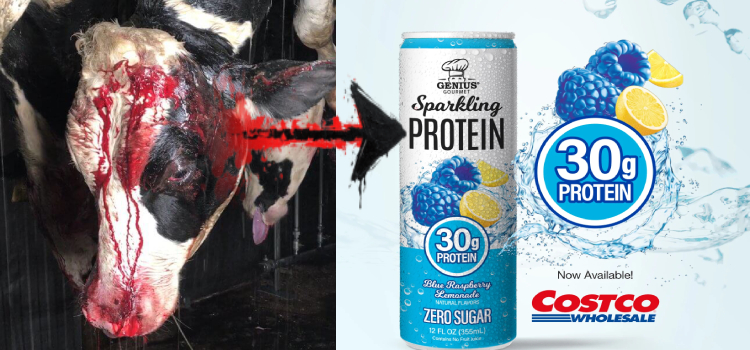
In December 2025, an incident at the Costco @Costco warehouse in Lawrenceville, New Jersey revealed a troubling blind spot in the company’s food sampling program—one that risks violating the religious and ethical dietary practices of many of its members.
During a routine visit, Costco’s third-party sampling partner, CDS (Club Demonstration Services), was offering samples of Genius Gourmet’s Sparkling Clear Protein Water. The product contains bovine collagen, a fact not disclosed to members at the sampling station. For many Hindus—who not only follow vegetarian diets but also abstain specifically from bovinederived ingredients—this omission is not a minor oversight. It is a direct conflict with deeply held religious principles.
A Pattern of Avoidable Harm.
Over the course of thirty minutes, I spoke with several Indian members, all of whom identified as vegetarian. When informed that the beverage contained cow collagen, every single one declined the sample. Their reactions were immediate and consistent, underscoring how essential ingredient transparency is in a sampling environment.
Unlike purchasing a packaged product—where the consumer has the opportunity and responsibility to read the label—sampling is fundamentally different. The product is handed to shoppers in a cup, without packaging, often while they are multitasking or navigating a busy warehouse. Expecting members to hunt down a label in this context is unrealistic and dismissive of the way sampling actually works.
When I raised the issue with the CDS manager and Costco store leadership, I requested a simple, reasonable solution: a clear sign indicating that the product contained animal-derived ingredients. The response was a flat refusal, accompanied by the claim that “members should read the labels.”
Legally Permissible, Ethically Irresponsible.
To be clear, Costco may not be violating any law by failing to disclose animal-derivedingredients at sampling stations. But legality is not the standard a company of Costco’s scale and reputation should hide behind.
Ethical responsibility extends beyond compliance. It includes respecting the cultural, religious, and moral values of the people who sustain the business. Vegetarians and bovine-abstaining Hindus make up a significant portion of Costco’s membership—and therefore its revenue. Ignoring their dietary boundaries simply because the law does not require disclosure is an abdication of ethical duty.
A company that prides itself on member loyalty cannot selectively apply that principle only when convenient.
Silence from Leadership.
After the incident, I reached out to Costco’s CEO, Ron Vachris. I filed a formal complaint through the company’s EthicsPoint grievance system. I contacted Genius Gourmet’s leadership as well. To date, none have responded.
This silence is not just disappointing—it signals a systemic unwillingness to engage with legitimate concerns from a diverse customer base. When a company fails to acknowledge harm, it compounds it.
Why This Matters
For many Hindus, consuming bovine products is not a dietary preference—it is a profound religious boundary. Violating that boundary, even unintentionally, can cause emotional distress, spiritual conflict, and a sense of betrayal. Sampling programs must be held to a higher standard of transparency precisely
because they bypass the normal safeguards consumers rely on. When a company hands you a cup of something to drink, you trust that you are not being misled—intentionally or otherwise.
A Path Forward
Costco can easily correct this issue by implementing three straightforward measures:
: Prominent Ingredient Disclosure – Mandatory signage at sampling stations for
any product containing animal-derived ingredients, especially those from culturally
sensitive sources such as bovine collagen.
: Cultural and Religious Sensitivity Training – Ensuring CDS staff and store
managers understand the significance of dietary restrictions among diverse
member communities.
: Accountability and Responsiveness – Timely responses to ethics complaints
and clear escalation pathways for unresolved concerns.
: Do for Hindus, Vegetarians, Vegans – What you would for any other identity, pointing out if it’s not kosher or halal. These steps are neither burdensome nor costly. They are simply the right thing to do.
Conclusion
Costco has built its brand on trust, value, and respect for its members. But trust requires
transparency, and respect requires acknowledging the ethical and religious boundaries
of the communities it serves.
Legality may set the floor, but ethics set the standard. Costco should choose to rise above the minimum.
Shivani Shah
For interviews or further information, contact: [Shivani Shah /
shah_s75@hotmail.com]