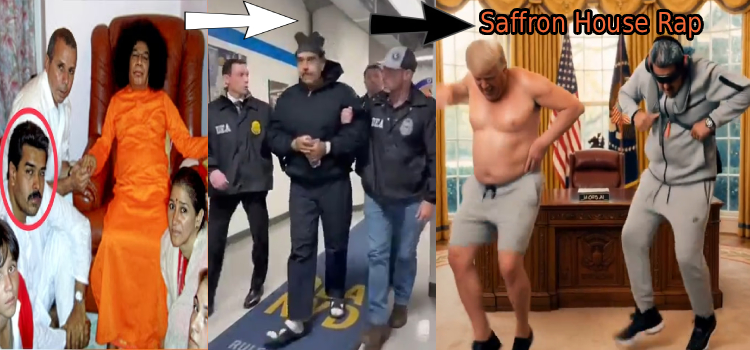
The arrest or some would say kidnapping of Nicolás Maduro, along with his wife Cilia Adela Flores, from Venezuela to the USA by the US government, is mainstream news, especially how hoodie-dressed Maduro prep walked with police officers through New York City, the birthplace of Hip Hop, seemed so happy without a care, as he greeted the public watching with happy new year.
But also in the news is his past of going to India with his wife, where he visited Puttarpati, the abode of Guru Sathya Sai Baba. Here, he spent some time and even had a picture of Baba next to his desk in the National Assembly of Venezuela. He also had an official day of mourning for the passing of the Guru back in 2011, which is why we are sure, sooner or later, the Hinduphobes will claim this is proof that the dreaded hand of Global Hindutva is running Venezuela.
A few months back, on Sathya Sai Baba’s 100th birthday anniversary, PM Modi gave a talk on Baba’s social work, which includes free medical care, free education in India and and across the world, where even in the US, Baba devotees help the poor with free healthcare, food and even shelter which is why he’s admired by many across the public and political spectrum in India and also outside.
 But it was a few days later, after the birthday event, at the Shri Ram Janmabhoomi Mandir Dhwajarohan Utsav, PM Modi said that India must completely break free from the residues of British colonialism still present in India over the next decade, which means the outdated Indian inferiority complex left over from the British Raj that anti-Hindu Indians and also even pro-Hindu Indians share.
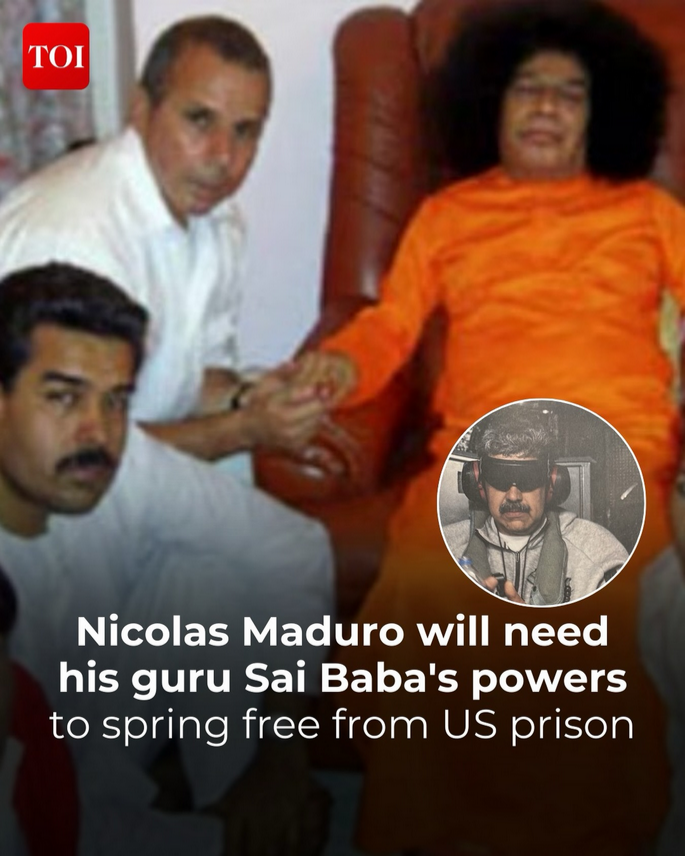
It’s total embarrassment and burden even for us Western-born who ironically aren’t colonised in the same country that colonised these Indian ‘caste’ of – Colonised Gunga Dins – (subservient indians) as reflected by a journalist in a recent Times of India article about Venezuelan leader Nicolás Maduro’s spiritual ties to Sathya Sai Baba titled,
“Nicolas Maduro will need his guru Sai Baba’s powers to spring free from US prison” by a potbelly chap-pati called Chidanand Rajghatta where he ends it with,
 As Maduro and Flores were perp-walked into Brooklyn’s Metropolitan Detention Centre,famous for its squalid conditions and other “celebrity” inmates, like Sean “Diddy” Combs and Luigi Mangione, they will need all of the late Baba’s divine blessings and powers to spring free.
 He basically reduces a major globally respected Hindu Guru to a caricature, where he engages in Hinduphobic frameworks that give the ammo to Hinduphobic racists and religious extremists. This is also a good example of what PM Modi referred to as part of the colonial mindset still hanging around in India like a pair of smelly, unwashed socks, which we will wash with our noses closed, to dissect and expand further in and beyond the article.
Mischaracterising Hindu Spirituality
The headlines’ opening and ending present Maduro’s relationship with Sathya Sai Baba in a tone that often trivialises and mocks Hindu Gurus and Hindu beliefs, which are already present in the mainstream.
So, instead of treating the subject with respect appropriate for a major religion, the article leans into the exoticism of Indian spirituality by implying a Hindu Guru is a joke or quackery — an approach rarely taken when discussing Western religious figures in similar geopolitical contexts.
This is not neutral reporting. It perpetuates a Western-centric and racist bias in global journalism by a typical subservient indian wanting a pat on the back from the ghost of Robert Clive and the Raj. When Hindu spiritual traditions are invoked, they become fodder for ridicule rather than legitimate subjects of inquiry.
“Fuzzy-haired”
The article further claims that Maduro became a follower of Sathya Sai Baba through his wife, described in the text as “fuzzy-haired” The use of the phrase “fuzzy-haired” is racist language, historically used to demean Afro-descended hair textures and to signal inferiority through physical description.
So hair texture contributes nothing to political analysis, legal context, or public understanding. Its only function is ridicule, which is how racism often operates today, not through slurs, but through unnecessary descriptors deployed to diminish dignity while preserving plausible deniability.
When journalists reach for such language, it is not ignorance. It is a habit. And habits are ideological in colonial laughter, especially when used in a context that diminishes dignity or frames cultural difference as odd or humorous, which is more troubling when this ridicule comes not from a Western tabloid but from India’s most prominent English-language newspaper.
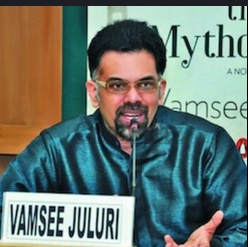 This is the deeper pathology Professor Vamsee Juluri from the University of San Francisco has long identified as “self-orientalism. The Indian elite press often adopts the tone of Western liberal mockery toward its own civilizational traditions, mistaking self-contempt for sophistication.
The reporter’s voice is not neutral. It is performative. It signals to a presumed global audience: “We are not like them Gora Sahib’. “We can laugh at this too, ‘Gora Sahib”, which really reflects the insecurity and the mental state of colonised, subservient Indians.
The “Godman” Trigger
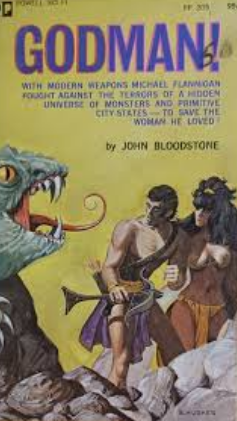 There is a single word that repeatedly exposes the fault line in Indian English media. That word is “Godman.” This trigger word reveals the bias and the habit of Hinduphobic journalism, which also makes its appearance in the same article. It appears with clockwork regularity whenever Hindu spiritual figures are discussed. Sathya Sai Baba. Sadhguru (Jaggi Vasudev). Sri Sri Ravi Shankar. Others too numerous to list. The pattern is consistent, and so is the intent.
“Godman” is not a descriptive term. It is a Hinduphobic trigger word, deployed to activate associations of cultism, irrationality, manipulation, and danger.
Its a word with a script attached where the reader is nudged toward a familiar mental movie. A little Indiana Jones and the Temple of Doom with Maula Ram doing the French Can-can, holding sacrificed heads for a little orientalist pulp fiction or a little Netflix movie for the horror addicted audience. The implication is always the same: Beware of the mystical Hindu Pagan Satanic Godman Guru figure that even Stephen King is so scared to write about.
This script is never applied evenly, as serious newspapers wouldn’t be framing with Popes or Pastors, a Jewish rabbi, or a Sufi pirs or Mullahs as “Godmen,” or the outrage would be immediate. Editorial apologies would follow. Careers would be at risk. Even when controversies exist, Western religious leaders are named by title, institution, or movement, not by a trigger word that already contains judgment.
Only Hindu figures are routinely portrayed in this Godman Pennywise character. With Hindu figures, mockery is still permitted. That asymmetry is called Hinduphobia.
From Journalism to Cultural Policing
When outlets like the Times of India or other Indian media outlets casually deploy “Godman,” they are 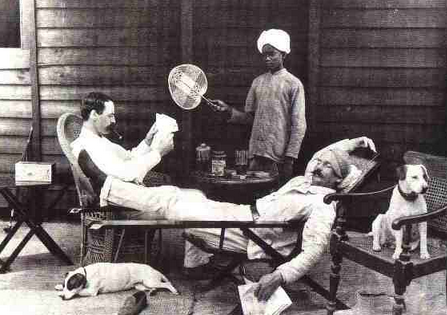 not reporting. They are signalling. Signalling distance from those pagan savages. Signalling superiority. Signalling that the writer knows better than the tradition being discussed because he’s civilised in a Western context, which really means the punkah wallah from the comedy series ‘It ain’t half hot mum’, as how these Indians are often seen in the same West that they want a pat on the back from.
This is not courage. It is a compliance with an old colonial reflex, one that Indian elites have unfortunately internalised. Mock your own ancient civilisation first, and you will never be accused of taking it seriously.
Further, Professor Vamsee Juluri points out that this posture is not secularism. It is elite insecurity. A fear that treating Hindu traditions with intellectual seriousness might jeopardise one’s standing in a globalised, Western-facing discourse.
Disbelief Is Not the Issue
Let us be clear. According to Hinduism, one is free to criticise any spiritual leader. One is free to reject their teachings. One is free to investigate wrongdoing where evidence exists, including questioning the Gods, as Hinduism is not about blind faith but having substance in the faith with a pure heart and mind to then act on either serving humanity or defending it against Adharma.
What is not acceptable is embedding contempt into polished vocabulary. So calling someone a “Godman” does not add clarity or fairness. It adds a Hinduphobic bias. It does not inform the reader. It mentally primes them to blindly see deep spiritual ancient philosophy, social service, theology, and lived religious experience into a single sneering label as the dreaded ‘Godman’
Why This Matters
Words shape perception. When Hindu spirituality and its Gurus are constantly framed through ridicule, it trains audiences to see a billion people’s traditions as inherently primitive and uncivilised. Over time, this becomes normalised Hinduphobia in terms that sound polite and urbane.
Indian media cannot claim maturity while continuing to recycle colonial tropes. It cannot demand respect abroad while performing self-erasure at home.
Hinduism is not a fringe belief system; it is the oldest surviving religious and indigenous tradition with a billion-strong global growing community. Spiritual teachers such as Sathya Sai Baba and others have and still influence millions worldwide. Describing such figures in terms that implicitly ridicule their followers or dismiss their tradition’s seriousness betrays a lack of cultural sensitivity and fairness.
Contrast this with how journalists treat Abrahamic faith leaders or Western spiritual movements when they intersect with politics. In those cases, reporters are cautious with religious framing.
But in this same article’s casual suggestion that Nicolás Maduro, Sean “Diddy” Combs and Luigi Mangione would “need divine help” to escape prison invokes a stereotype that Hindu Gurus are conmen who use magic tricks learned from magician books ordered from Amazon to fool the masses.
The Larger Issue: Hinduphobia in Media, Cowardice Disguised as Cleverness
There is nothing progressive about recycling colonial tropes while pretending to be modern. The real cowardice lies in choosing the safest possible target while avoiding every harder question the story could have asked.
Why is spiritual belief framed as absurd only when it is Hindu? Why does Indian English colonised media still treat its own religious traditions as an embarrassment rather than an inheritance? Why is racialised language tolerated when it flatters elite sensibilities? These questions are avoided because they are uncomfortable. Mockery is easier.
A newspaper that cannot distinguish between critique and caricature eventually becomes one. The Times of India article in question tells us far less about Nicolás Maduro, Sathya Sai Baba, or geopolitics than it does about the enduring anxieties of India’s Anglophone media class.
If journalism is to mean anything beyond cheap irony, it must recover moral seriousness. That includes the courage to critique power without sneering at belief, and the discipline to write without reproducing racial and civilizational contempt.
Until then, such articles will remain a timid laughter echoing from a colonial past that refuses to let go. When mockery replaces journalism, then all it means is cowardice. And this particular kind of cowardice thrives in postcolonial newsrooms like the Times of India and others.
It does not announce itself loudly. It dresses itself as wit, irony, or global savvy. It punches sideways rather than upward. And it reveals itself most clearly when Hindu traditions become safe targets for derision.
So this Times of India article invoking Sathya Sai Baba in the context of Nicolás Maduro’s legal troubles is a textbook example of a wider problem in India in its academia and media, still stuck in outdated colonial narratives that are in the British Museum.
Punching the Easiest Target
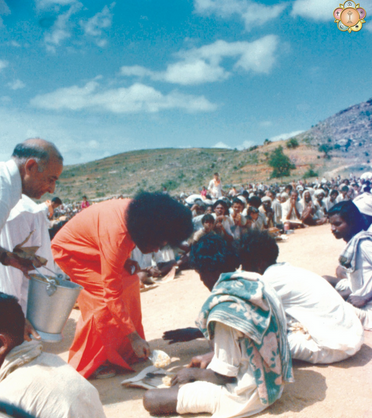 What makes this piece especially revealing is not its content, but its choice of target. The reporter does not interrogate American carceral power, imperial reach, or international legal hypocrisy. That would require courage. Instead, the article reaches for the familiar, colonial reflex, mock Hindu Gurus, and Hindu spirituality.
Sathya Sai Baba becomes a punchline. Faith becomes superstition because it can’t free you from Brooklyn’s Metropolitan Detention Centre. Devotion becomes an exotic comedy spectacle. This is not accidental. Hinduism remains one of the few global traditions that elite English-language Indian journalism feels safe ridiculing without consequence.
Responsible journalism about religion requires:
1/Respectful tone, free of belittling descriptors
2/ Contextual understanding of traditions discussed.
3/Avoidance of racialised language or Hinduphobic stereotypes.
Conclusion
If the Times of India and other Indian media wish to maintain credibility, editors must demand reporting that informs rather than disparages, that explains rather than exoticises, and that respects the diversity of the world’s spiritual traditions rather than turning them into punchlines. And most of all, they need to decolonise themselves by having seminars and courses about how historical hinduphobic, racist and religious narratives update their propaganda in acceptable tones to fool the public.
But also the Hindu side, which also suffers from Gunga Din-ism, falls for the colonial trap when referring to these same subervient Indians as ‘ left wing, or seculairsts or progressive liberals or woke’ when in reality they are not, but they fraudently use these Hindu accusations thrown at them to show to Gora Sahib ‘look we are secular, liberals, left wing and progressives and we eat beef which even the Right wing Hindu fascists are calling us, so peeze give me a pat on the back and visa to the west Gora Sahib’ which is why it’s common to see Indian ‘Marxists’ wanting a visa to the capitalist West to live in capitalist luxury with a stamp of approval from Gora shaib on the’ left or right. Decolonisation has to happen across the Indian mindset.
As the world reacts to the dramatic capture of Venezuelan President Nicolás Maduro, a lesser-known and surprising chapter from his personal life has resurfaced. In this News9 explainer, we explore Maduro’s unexpected spiritual connection to India’s Sathya Sai Baba — a bond that stands in sharp contrast to the hard power politics now surrounding his fate. The video traces Maduro’s 2005 visit to the Prasanthi Nilayam ashram, his reported private audience with Sathya Sai Baba, and how Venezuela developed a long-standing association with the Indian spiritual leader, including becoming home to the first Sathya Sai International Organisation outside India. It also looks at why Venezuela observed national mourning after Sai Baba’s passing and how Maduro continued to publicly acknowledge this spiritual influence years later. As geopolitics dominate headlines, this untold India chapter offers a rare glimpse into the personal beliefs and influences that shape global leaders beyond ideology and power struggles.
PM Modi addresses birth centenary celebrations of Sri Sathya Sai Baba at Puttaparthi, Andhra Pradesh
PM Modi at Shri Ram Janmabhoomi Mandir Dhwajarohan Utsav said India must completely break free from Macaulay’s colonial mindset over the next decade. He highlighted India’s ancient democratic traditions, suppressed for centuries, and said freeing ourselves mentally is essential for building a developed Bharat by 2047.
“More than the medicines they prescribe, it is the sweet, gentle words, the love, and the compassion they show that can heal patients faster and more completely.” This has been Bhagawan’s guiding message to the doctors serving in His institutions: “Treat every patient as your own-as family, as dear friends-and serve them with unwavering love and care.” The Sai Medicare Mission, which began in 1954 when Bhagawan laid the foundation stone for the Sri Sathya Sai General Hospital, continues to uphold this sacred approach to healthcare. Over the decades, this mission has flourished into a vast and ennobling ecosystem, including two world-class Super Speciality Hospitals and several Mobile Hospitals. This documentary offers a window into that noble journey — a journey of holistic healing that has touched millions, spreading joy, hope, and wellness like a divine juggernaut of selfless service.
.
The ‘Secret’ Behind the BBC’s Secret Swami
Even the BBC’s Hindu Bashing has some Karma
Gunga Din Indians that Hate Anything ‘Hindoo’
Video : CIA’s Findings On Sathya Sai Baba : Central Intelligence Agency, USA Declassified Files
Video : False propaganda about Sai Baba – Anti Hindu conspiracy ?
Postal department to release stamp on Sathya Sai Baba
Devout Hindu rolls for over 5 months to Sathya Sai Baba Ashram
Sathya Sai Baba – Eternal Work for Mankind
Video : Vamsee Juluri Debate On The Rise Of Hinduphobic Neo-Colonialism
Video : Hinduphobia – A Media Studies Perspective by Professor Vamsee Juluri
Use of the term “Hinduphobia” 1883-1997
Video : Hinduphobia in Pop Culture – Vamsee Juluri
Video : BBC ON TRIAL – FULL DOCUMENTARY
.