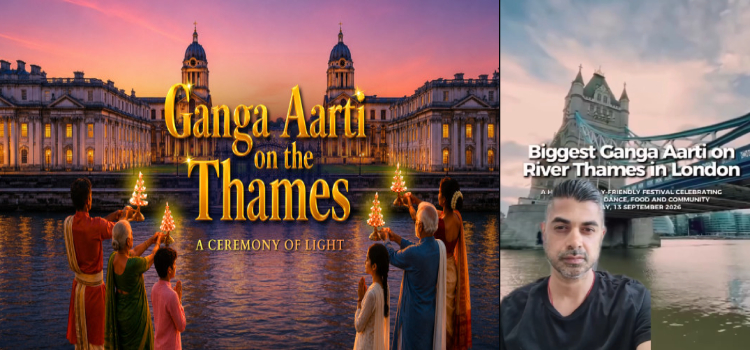
With the upcoming Ganga Aarti on the River Thames by the Chinmaya Mission UK on Sunday 13th September, there have been some negative reactions from Hindus themselves.
This article arose in response to a reel shared by Laav Patel, raising the question of whether bringing Gaṅgā Ārati to the River Thames is appropriate. He further suggests that the Gaṅgā Ārati should remain confined to India, which misunderstands an important distinction within Hindu thought: Gaṅgā has a uniquely sacred geographical manifestation, but the sacred is not confined by geography.
So Why Does Gaṅgā Ārati Belong On the Thames Too?
So let’s see the answers within Hindu scripture and theology itself. Well, first, the Vedas recognise the sacredness of all waters.
Ṛg Veda 7.49.2 invokes waters of many origins:
«yā āpo divyā uta vā sravanti
khanitrimā uta vā yāḥ svayaṃjāḥ…
tā āpo devīr iha mām avantu»
It speaks of celestial waters, flowing waters, waters obtained by digging and naturally arising waters, concluding with a prayer that these divine waters protect the worshipper. The crucial expression is āpo devīḥ, divine waters.
The famous Nadī Sūkta, Ṛg Veda 10.75.5, likewise invokes numerous rivers:
«imaṃ me gaṅge yamune sarasvati
śutudri stomaṃ sacatā paruṣṇyā…»
Gaṅgā, Yamunā, Sarasvatī, Śutudrī, Paruṣṇī and other rivers are addressed together. Vedic sacred geography already recognises a plurality of revered rivers. None of this diminishes Gaṅgā’s unique status. Bhagavad Gītā 10.31 gives her an extraordinary distinction when Śrī Kṛṣṇa declares:
«srotasām asmi jāhnavī»
“Among rivers, I am Jāhnavī, the Gaṅgā.”
Gaṅgā therefore possesses her own sacred identity, religious traditions, tīrthas and physical manifestation. But performing Gaṅgā Ārati beside the Thames does not require claiming that the Thames has geographically become Gaṅgā. It means that Hindus standing beside another great river invoke Gaṅgā Mātā and approach water through the sacred consciousness that Sanātana Dharma has cultivated for millennia.
Traditional Hindu ritual already embodies this principle. During pūjā, Gaṅgā, Yamunā, Godāvarī, Sarasvatī, Narmadā, Sindhu and Kāverī are traditionally invoked into the water used for worship.
Sacred geography can therefore be ritually made present without erasing physical geography. There is even an ancient linguistic connection. There is a fascinating additional dimension to the Thames itself.
A River Thames history site states that many etymologists connect Thames with Sanskrit Tamasa, understood as “dark river” or “dark water”, proposing an ancient linguistic relationship transmitted through Celtic languages. The precise historical route should not be overstated. Modern etymology more cautiously traces Thames through the ancient Brittonic Tamesa/Tamesis, probably associated with “dark”, while recognising cognates across the wider Indo-European language family, including Sanskrit tamas, “darkness”.
That distinction is important. It would be historically unsafe to claim that Indians simply named the Thames. But the linguistic kinship is nevertheless striking.
The words belong to an ancient Indo-European linguistic world in which Sanskrit and the ancestral languages of Europe preserve related roots. So even at the level of language, India and ancient Britain are not the completely disconnected civilisational worlds that a simplistic “keep Gaṅgā in India” argument might imply.
What about Britain’s own sacred traditions? The fact that the Thames possessed sacred significance within Britain’s ancient pre-Christian cultures is not an argument against Gaṅgā Ārati. If anything, it makes the symbolism richer.
Hindus do not need to erase Britain’s indigenous traditions, appropriate them or declare that the Thames is secretly Gaṅgā. We can respect the Thames as the Thames while approaching its waters through our own dharma. There is something profound about two ancient spiritual cultures recognising that a river is more than a resource.
A Hindu temple in London does not turn London into Varanasi. A homa performed in Britain does not turn Britain into India. Sūrya does not cease to be sacred beneath an English sky. Śiva does not cease to be omnipresent at India’s borders. Why, then, should Hindu reverence for sacred waters suddenly become geographically impossible?
Indeed, if ancient Britons also perceived sacredness in the Thames, then offering ārati by Hindus there need not represent disrespect toward that heritage at all, but it actually awakens many of them to see the ancient sacredness of their rivers and nature that they have lost, after being conquered by a Middle Eastern Christianity that even has churches built on their ancient sacred pagan temples and sites. This is why far-right Christian fundamentalists know that ‘Global Hindutva’ really means a ‘Global Pagan Ancient Reawakening’ thanks to the largest remaining ancient pagans in the world known as the Hindus.
So Hindus represent another civilisation recognising the sacred dimension of the same river. This is perhaps the most important distinction. A lamp offered beside the Thames does not colonise the river, rename it or assert Hindu ownership over it.
Ārati claims nothing. Ārati offers. It is an offering of light, gratitude and reverence.
Hindus living in Britain should therefore not be expected to practise a permanently transplanted Hinduism in which sacredness always exists somewhere thousands of miles away. Sanātana Dharma can take root wherever Hindus sincerely live and worship, while respecting the history and traditions of that land. Gaṅgā remains Gaṅgā. The Thames remains the Thames. Yet the Hindu can bow before both without contradiction. Bhārata is sacred. Gaṅgā is uniquely sacred. But Īśvara is not bounded by Bhārata.
To offer Gaṅgā Ārati beside the Thames is therefore not to replace Britain’s sacred geography with India’s. It allows two truths to stand together: the Thames possesses its own ancient identity and sacred history, while Hindus standing upon its banks have every right to encounter those waters through Sanātana Dharma.
Perhaps that is the most appropriate response to the concern that Gaṅgā Ārati belongs only in India.We do not need to call the Thames “Gaṅgā”. We do not need to deny Britain’s indigenous relationship with its river. And we certainly do not need to leave our own sacred worldview behind when we approach its banks.Sanātana Dharma- Hinduism is not diminished when carried beyond India. Its universality is revealed when its eternal principles are lived authentically wherever Hindus call home.
Ganga Aarti on the Thames — a little piece of India, right in the heart of London 🇮🇳🪔🇬🇧
What if you could experience the sacred beauty of a Ganga Aarti without leaving London? 🥹✨
As part of Totally Thames Festival 2026, Chinmaya Mission UK invites you to Ganga Aarti on the Thames — a beautiful, family-friendly celebration of Indian music, dance, food, culture and community, set against the iconic River Thames. 🌊🪔
📍 Old Royal Naval College, Greenwich
📅 Sunday, 13 September 2026
⏰ 4:00 PM – 8:00 PM
🪔 Aarti at 7:15 PM
The evening will culminate in a beautiful ceremony of light, inspired by the timeless tradition of Ganga Aarti — a celebration of gratitude, togetherness, nature and our connection to India’s sacred rivers. ✨
There’s something incredibly special about bringing this tradition to the Thames — creating a beautiful connection between India and the UK, right here in London. ❤️
The celebration is also being guided by a commitment to nature and sustainability, with no items being placed into the River Thames. 🌱
Whether you grew up watching aarti by the ghats of India, miss the feeling of home, or simply want to experience a unique piece of Indian culture in London — save this one for September. 🪔✨
– nine2fivelife