While the founding members ensured the United States would be a secular republic—separating church and state—they did so with the bloody lessons of Europe in mind. The Christian civil war between Protestants and Catholics over which version of the “one true God” would prevail culminated in the Thirty Years’ War, one of the deadliest conflicts in history.
The danger of sectarian hatred is not merely a relic of the past. Even today, violence emerges from within Christianity itself. Recently, in a chilling example, suspect Thomas Sanford allegedly opened fire at a Mormon church, killing innocent victims, who, according to one of his close friends, had said the Mormons were “the anti-Christ trying to take over the world.”
The aftermath was telling online, some self-professed Christians excused the violence, insisting that Mormons are not “real” Christians and had somehow brought it upon themselves. Such incidents are stark reminders of why America’s architects swore never to let sectarian fire consume their new republic.
This separation, however, never sat well with the American church, especially the evangelicals. From the beginning, Christian groups have sought ways to bend secular governance toward their agendas, slipping through the many “back doors” of the White House. Each generation saw new campaigns to privilege Christianity in public life, and today, that long struggle returns with fresh intensity.
Every empire tells itself a story about God. Christian Conquered Rome declared itself the defender of Christianity against paganism. The Caliphates saw themselves as guardians of Islam against infidels. America, for more than two centuries, has oscillated between the promise of pluralism and the instinct for religious monopoly.
Unfortunately the American political establishment that’s already under the influence of the pharma industry, along with the military industrial complex, is also under the heavy influence of the Right Wing Christian lobby, which is why even though he can be criticised for his political policies, Obama, as President who unbanned Modi to the anger of many anti-Hindu groups and the right wing Christian lobby that once pushed the U.S. government under the Republicans to deny Narendra Modi a visa in 2005 , faced further hate when he put the Christian lobby into cardiac arrest with a Christian rightwinger Glenn Beck making a mocking video about Obama carrying a small statuette of Lord Hanuman, a revered Hindu deity in his pocket, as a source of inspiration which he mentions in his book, who was introduced to by his step father Lolo,
“There standing astride the road was a towering giant at least ten stories tall with the body of a man and the face of an ape. That’s Hanuman, Lolo said as we circled the statue, the monkey-god. I turned around in my seat, mesmerized by the solitary figure, so dark against the sun, poised to leap into the sky as puny traffic swirled around its feet. He’s a great warrior,” Lolo said firmly, “strong as a hundred men. When he fights the demons, he’s never defeated.”
This is why Tulsi Gabbard, who is part of the present Trump Administration, often also gets attacked by the same Christian network and others. We see non-stop Hinduphobic attacks from Christians also on Vivek Ramswamy, who is running for Governor of Ohio.
With Donald Trump to his credit, in 1976, emerging as a real-estate businessman in New York City, he saved and supported the Hindu Jagannath Rathayatra festival by providing his train yard for the construction of the Rathayatra carts for free.
Fast-forward to the present. When Donald Trump hosted a Diwali celebration in the Oval Office, it was, on the surface, a welcome acknowledgement of America’s pluralism. Yet, his running mate J.D. Vance was notably absent — a silence that spoke volumes. The absence itself may seem minor, but in the context of rising Christian nationalism, it highlighted the unease some politicians feel about publicly embracing non-Christian faiths, especially late,r when he entered into a controversy wanting his wife, who is a Hindu, to convert to Christianity
Meanwhile, Trump’s gesture drew criticism from parts of the Christian right, who denounced the Hindu festival as “pagan” or “anti-Christian.” The same voices that demand prayer in schools condemned the lighting of a lamp symbolising truth over darkness. This contradiction exposes an enduring double standard: religious freedom for some, religious tolerance for others.
Still in Donald Trump’s second act, he has to walk a tight rope where the old crusade resurfaces in modern form. When he promises Bibles in schools and surrounds himself with pastors who call Hinduism “demonic,” he is not merely appealing to a domestic voting bloc. He is participating in a 2,000-year drama of Christian supremacy and the demonisation of all “pagans”, of whom the worst are the Hindus, who through indigenous warrior resistance survived against the fascist ideologies of the one ego god and the one book that’s enslaved most of the ancient world.
So for Hinduism, a civilisation that produced the Rig Veda, the Upanishads, and millennia of pluralistic philosophy, along with giving the world a version of the numeral system that advanced technology and science and much more, is reduced in evangelical imagination to little more than “ satanic idol worship,” like we saw over the Hanuman statue in Texas by the devout Christian Republican Alexander Duncan.
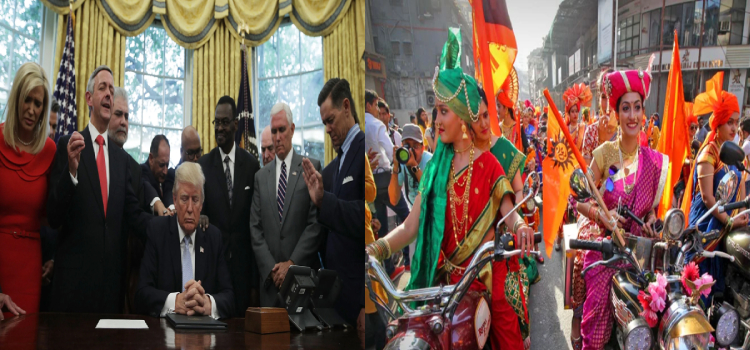
If it’s a Pat Robertson or a Robert Jeffress who, at a Hanukkah party, claimed that Jews, followers of Islam, Mormonism, and Hinduism are “destined for hell,” it is the mindset of many.
That same event was also hosted by President Trump, where Jeffress was introduced as a “tremendous faith leader.” While the statements weren’t made by Trump himself, his association with them is politically meaningful.
Figures like Lance Wallnau (a prominent evangelical preacher) connect religious ideas to political identity, such as seeing President Trump as a “biblical King Cyrus” figure. While those claims are theological/prophetic rather than direct commentary on other religions, the worldview tends toward a framing where Christianity is the normative.
The late Charlie Kirk had used rhetoric that conflates “secular” ideas or “unWestern” culture with “pseudo-paganism” or “decline of Christian civilisation.” For instance, in 2022 Kirk expressed concern about climate change as “pseudo‐paganism.”
They are not inventing something new. They are drawing from the same script that also condemned Europe’s indigenous traditions as witchcraft, leading to many innocent women being burnt at the stake, declared Native Americans heathens, and justified centuries of missionary aggression, especially in India.
Which we know they would be whispering into Trump’s ears, recasting India itself as a pagan adversary to turn Hinduism into the next “enemy,” especially as it’s already been popular from the 60s with the hippy movement, with many musicians like the greatest band ever known The Beatles, along many actors and actresses like Julia Roberts and many other other artists practising some form of Hinduism with the mass popularity of Yoga and other Hindu practices with the general public also.
Trump, Evangelicals, and the “Christian Nation” Project
Evangelical alignment with Trump: Roughly 80% of White Evangelicals supported Trump in both 2016 and 2020. Leaders framed him as a “chosen instrument” to defend America’s Christian heritage.
And many of his public events emphasise “Christian values,” religious freedom (from a Christian perspective), opposition to LGBTQ issues, abortion etc.
In these settings, non-Christian religions are often not mentioned or are implicitly outside the privileged circle.
Bible in schools movement: In June 2024, Trump declared, “We will bring back the Bible into our schools… the founding fathers would be thrilled.” GOP-led states such as Texas, Oklahoma, and Florida are already pushing mandatory Bible courses or Ten Commandments displays. Louisiana passed such a law in 2024.
Speeches on Prayer / Religion in Public Life
A recent example: Trump called for weekly public prayer gatherings ahead of the 250th anniversary of the U.S., donated his family Bible to the Museum of the Bible, and pushed policies that “allow clergy to engage in political endorsements.” He also stated, “To have a great nation, you have to have religion… there has to be something after we go through all of this, and that something is God.”
Critics pointed out that these moves may marginalise those who are non-Christian: “‘What does this say to a Muslim, a Hindu, a Jew, an agnostic?’ … ‘It tells them they are outsiders.’”
Christian nationalism: Groups like Project Blitz insist America was “founded as a Christian nation” and must be returned to that state.
Evangelical Narratives and Pagan Hatred
Historically and today, evangelical Christianity carries strong anti-pagan sentiment. The hostility Hinduism faces in America today is the latest chapter in a much older story. Early Christianity dismantled Roman temples. Europe’s indigenous faiths were branded as satanic, where old churches are built on Pagan temples. Native American spirituality was exterminated under the cross. Hinduism, with its plurality of gods and philosophies, now inherits that historic role of “the pagan other.”
Trump-era reinforcement: When Trump’s base champions “Bible Nation” rhetoric, it implicitly sidelines non-Abrahamic traditions. Hindus, Sikhs, Buddhists, and Native faiths become invisible or foreign.
Hate spillover: This worldview explains why Hindus in the U.S. are sometimes targeted with slurs like “idol worshipper” or “Satanist.” In California’s textbook controversies, Hindu parents who objected to the misrepresentation of their tradition were accused of whitewashing caste, a political proxy for religious prejudice.
How This Intersects With Anti-Hindu Sentiment
The claim that anti-Indian sentiment in the U.S. is increasingly about Hinduism itself gains credibility when laid against the rise of evangelical Christian nationalism.
Religious rivalry: Evangelical Christianity requires defining the “other” as demonic or false. Hindus fall neatly into that slot.
Political leverage: Trump’s embrace of Christian nationalism emboldens policies privileging Christianity in public life — indirectly delegitimising Hindus.
Diaspora tensions: In areas with large Indian populations, Hindu temples, festivals, and even vegetarian practices are branded “foreign” or “un-American.”
Evangelical Christianity vs Hinduism
Factor Evangelical Christianity (Trump’s Base)
Political Influence Massive – shapes GOP policy, courts, and education laws.
Narrative in Public Sphere “Bible Nation,” a defence of Christian heritage,
Hinduism in the U.S. (1% of population)
Political Influence – Minimal
Caricatured with (caste, cows, curry) while facing increasing Hinduphobic racist and religious hate by both the right and the left.
Treatment of Other Religions: Islam = Rival enemy; Judaism = Conditional ally; Pagans = Totally Demonic.
Yet Islam is often treated as a tactical ally when it comes to opposing the heathen kafir many gods idol-worshipping Hinduism.
This is why the United States has consistently given Pakistan a free pass, despite its long record of atrocities. As far back as 1971, when Bangladesh was born, President Nixon openly backed Pakistan even as its military and jihadist proxies slaughtered nearly three million people—most of them Hindus.
Even Senator Edward Kennedy condemned the genocide, but Washington chose to look the other way. Decades later, Pakistan sheltered Osama bin Laden, the mastermind of 9/11, and continues to serve as an epicentre of global jihad.
Yet, instead of sanctions or isolation, its leaders have been courted on the world stage. In 2025, Donald Trump rolled out the red carpet for Pakistan’s Leader, who openly threatened India and the world with nuclear annihilation. To make matters worse, U.S. aid and billions in military assistance flowed to Pakistan immediately after terrorist attacks in India that deliberately targeted and killed Hindu civilians. The message is unmistakable: when the victims are Hindus, Washington’s outrage disappears.
This paradox, where Islam is cast as an enemy in one arena but becomes a convenient ally to eliminate the common Hindu Pagan Heathen Kafir, reveals how Hindus occupy a uniquely vulnerable place in America’s culture wars.
Impact on Hate Normalises exclusion of “un-Christian” groups. Leads to temple vandalism, prejudice, and stereotyping, eventually violence.
This uneasy alignment is visible not only in pulpits but in American academia. Figures like Audrey Truschke, a U.S.-based historian and a Christian ultra-right-winger who is also related to missionaries that have been working in India, make more sense once you dig up her past, She has repeatedly drawn criticism from Hindu groups for dismissing concerns about Hinduphobia, mocking Hindu deities on social media, and framing Hinduism primarily through the lens of caste and oppression while aligning with Islamist narratives..
Also, that’s never mentioned is the funding of Christian terrorist groups like the NLFT, National Liberation Front of Tripura, India, in the northeast, who have killed several Hindus, including Swami Shanti Kali Maharaj, who refused to convert to Christianity, with guns pointed at him which was followed by the killing of another Hindu called Jaulushmoni Jamatya by them. Also, Swami Lakshmanananda was killed by 6 Christian extremists. While back in the US, we are seeing the rise of temple vandalism, prejudice, and stereotyping.
The Evidence Trail
Rising hate crimes: FBI data shows anti-Hindu hate crimes have doubled in recent years. California reports nearly 25% of religiously motivated hate incidents target Hindus. Temples across Texas, California, and New York have been defaced, often with Nazi graffiti — ancient Hindu symbols twisted against the very community that birthed them.
Public demonisation: From Jeffress to Mohler, pastors linked to Trump openly call Hinduism demonic or satanic. A Missouri megachurch pastor even warned that yoga was created to invite “demonic power.” Trump does not need to echo these words himself; his embrace of these figures grants their rhetoric political legitimacy.
Christian nationalism as policy: Ten Commandments in classrooms, Bibles in schools — these policies enshrine Christianity at the expense of pluralism. Trump’s framing of America’s greatness as inseparable from Christianity makes clear that non-Abrahamic faiths have no seat at the table.
Academic Indictment: How Universities Enable Hindu Genocide Denial
Hinduphobia is not simply a matter of insults or stereotypes. It is the sustained erasure of persecution, resistance, and survival from the global record. Western academia has become one of its chief enablers, presenting prejudice as “critical scholarship” and rewarding genocide denial with legitimacy.
The Aurangzeb Whitewash
The Pre-Aurangzeb Precedent
The horrors of Aurangzeb’s reign did not emerge in isolation. For more than five centuries before his rule, waves of invasions had already unleashed systematic campaigns of slaughter, enslavement, and forced conversion across the Indian subcontinent. Beginning with Mahmud of Ghazni in the 11th century, who boasted of destroying temples and carrying off Hindu captives as war booty, a succession of invaders followed the same pattern: Muhammad Ghori, Qutb-ud-Din Aibak, Alauddin Khilji, and the later Delhi Sultans each waged holy wars that turned large parts of northern India into theatres of mass persecution. Contemporary chronicles record the deaths and enslavement of millions, the desecration of sacred sites from Somnath to Mathura, and the imposition of discriminatory taxes that targeted Hindus purely for their faith.
This long arc of violence formed the backdrop for Aurangzeb’s rule. Far from being an anomaly, he represented the culmination of centuries of institutionalised oppression—a ruler who took inherited policies of destruction and pushed them to their cruellest extreme. His reign was the continuation, not the beginning, of a centuries-long campaign to annihilate the last major non-Abrahamic civilisation still standing.
Aurangzeb’s reign (1658–1707) was marked by forced conversions, the destruction of thousands of temples, the imposition of the jizya tax on non-Muslims, and the executions of Hindu saints. For Hindus, his name is synonymous with state-sponsored persecution. Yet even with this historical record, modern academia attempts to invert victim and perpetrator. Scholars such as Audrey Truschke at Rutgers University strive to rehabilitate him as a “misunderstood ruler.” This is not scholarship—it is erasure. By praising a man who targeted Hindus as the “pagan enemy” of both mosque and church, Rutgers lends academic legitimacy to the denial of one of history’s most systematic campaigns against a living, ancient civilisation.
The Goa Inquisition: Europe’s Forgotten Holocaust in India
From 1560 onward, the Portuguese unleashed the Inquisition in Goa. Pagan temples were razed, Hindu rituals were outlawed, children were taken from families to be raised as Christians, and those who resisted faced torture or death. Yet Western universities that endlessly discuss the Spanish Inquisition seldom mention Goa. It remains one of the most under-taught genocidal projects in world history, excused because its victims were Hindus rather than Europeans.
Partition: The Silenced Pogrom
In 1947, the Partition of India created one of the largest forced migrations in human history. Millions of Hindus and Sikhs were driven from their homes; hundreds of thousands were slaughtered in ethnic and religious violence. Women were kidnapped, raped, and trafficked in the tens of thousands. Yet, in academic discourse, Partition is often framed as a “shared tragedy,” flattening the reality of Hindu and Sikh victimhood. When the perpetrators are excused and the victims erased, denial becomes the norm.
Hypocrisy in Academia
The hypocrisy is glaring. Western universities denounce Columbus, Rhodes, and Jefferson; their statues fall, their names are stripped from buildings, and their legacies are interrogated. Holocaust denial is criminalised across much of Europe, rightly recognised as a threat to justice and truth. Yet denial of Hindu genocide—under Aurangzeb and other muslim rulers or in Goa under the Christian Portuguese, or Partition or 1971 during the creation of Bangladesh, with nearly 3 million Hindus killed by the Pakistan army and its jihadists backed by President Nixon —is rewarded with tenure, book contracts, and prestigious academic chairs. Harvard, Yale, Rutgers, Oxford, and Cambridge claim to stand for diversity and inclusion, while hosting programs and scholars who mock Hindu deities and glorify Hindu oppressors.
The Erased Resistance
What disappears from classrooms is not just the violence but the defiance. Hindus mounted one of the greatest pagan resistances in human history, refusing annihilation under Aurangzeb, resisting the Inquisition in Goa, and surviving Partition against impossible odds. That story—of survival, resilience, and the preservation of dharma—is humanity’s heritage. Its omission is not accidental; it is part of a larger project to deny Hindus recognition as victims of genocide and as survivors of one of the longest continuous civilisational struggles.
The Indictment
Western academia stands guilty of enabling cultural genocide. By sanitising Aurangzeb, erasing Goa, and trivialising Partition, universities condition new generations to see Hindu suffering as unworthy of memory. They grant Hinduphobia academic respectability and rob Hindus of their place in the global narrative of human rights.
Until these institutions are held accountable—until they teach Hindu history with the same moral clarity they bring to the Holocaust or the Atlantic slave trade—they remain complicit in perpetuating injustices
Academic complicity: Hinduphobia does not thrive on theology alone; it is amplified in classrooms and universities. Christian right-winger Audrey Truschke has become emblematic of this trend. By trivialising Hindu concerns about prejudice, mocking deities online, and consistently reframing Hinduism through colonial tropes of caste and violence, she provides an intellectual veneer to what is essentially religious stereotyping. For many Hindu Americans, her work reflects how parts of the academy provide cover for anti-Hindu sentiment under the guise of scholarship. When such views enter mainstream discourse, they legitimise the marginalisation that evangelical rhetoric preaches from pulpits.
Historical continuity: Modi’s 2005 visa denial was not just about Gujarat; it was driven by the same Christian nationalist and missionary networks that now seek to frame India itself as a pagan civilisation needing redemption.
Implications: How Likely / How Real Is The “Christian Anti-Pagan” Narrative in Trumpism?
While Trump himself may not frequently publicly use harsh demonising statements about Hinduism, but it is very likely that in a Trump + evangelical partnership, rhetoric against non-Christian religions (Hinduism among them) will continue, especially from religious leaders.
Politically, we should expect policies, symbols, and cultural priorities to continue privileging Christianity, possibly at the expense of religious pluralism (or with less attention to non-Christian faiths).
Faith Office / Faith Advisory Board
Trump, together with evangelical adviser Paula White, re-launched a national faith advisory board in 2021. And in 2025 he signed an executive order to establish a White House Faith Office within the Domestic Policy Council. These offices tend to have very strong evangelical Christian representation. While not explicitly anti-Hindu, their composition and agenda imply privileging Christian viewpoints.
Speeches on Prayer / Religion in Public Life
A recent example: Trump called for weekly public prayer gatherings ahead of the 250th anniversary of the U.S., donated his family Bible to the Museum of the Bible, and pushed policies that “allow clergy to engage in political endorsements.” He also stated, “To have a great nation, you have to have religion… There has to be something after we go through all of this, and that something is God.”
Critics pointed out that these moves may marginalise those who are non-Christian: “‘What does this say to a Muslim, a Hindu, a Jew, an agnostic?’ … ‘It tells them they are outsiders.’”
Why Hindus Become Collateral
Evangelical monopoly: Only Christianity is seen as legitimate; everything else is “heathen.”
Media amplification: Criticism of Hindutva politics often feeds into existing bias, blurring the lines between right-wing and left-wing ideologies in their shared Hinduphobia. What begins as political discourse frequently devolves into cultural vilification, recycling colonial stereotypes that refuse to recognise Hinduism as a dynamic and plural spiritual tradition.
Small minority = soft target: At less than 1% of the population, Hindus lack the political clout of Jewish or Muslim advocacy groups.
Call to Action
Hindu advocacy must abandon its timid, very weak defensive posture and rise with conviction. The language of rights, justice, and equality—already dominating global debates—must become the vocabulary of Hindus who stand against prejudices against them and other indigenous people and the pagan movement.
Hindu organisations, activists and Hindu temples need to unitedly coordinate their efforts and act as first responders whenever Hinduphobic incidents surface. Numbers on the street change the conversation — visible, disciplined, and sustained public pressure forces institutions to account for their actions. Mass rallies and peaceful demonstrations outside places like Wikipedia HQ, university departments (Rutgers and others), media offices, and think tanks will be effective when they are strategic, highly visible, and repeatedly sustained until demands are met.
Do it smart, combine street action with petitions, legal complaints, targeted media campaigns, and rapid-response communications. Train marshals, secure permits, publicise clear demands, and present polished spokespeople so that every rally converts public attention into institutional accountability.
That means Hindu temples, our community’s strongest institutions, should sign a common pledge: to inform their congregations about Hinduphobic crimes, to educate visitors on the issue, and to mobilise members for mass protests when necessary. Every temple should also dedicate a space—a permanent exhibition room—to document the persecution of Hindus, past and present, so that every generation understands what is at stake and why their voices matter.
This is not about “right versus left.” Both camps, despite their public quarrels, converge when it comes to normalising Hinduphobia and perpetuating stereotypes about one of the last surviving indigenous civilisations on earth.
All these left-wing and right-wing political parties, media outlets, and academia must be held accountable. They must be challenged, confronted, and invited into open debates—where articulate Hindu voices can dismantle falsehoods before the public eye. Online outrage will not suffice. Professional Hindu academic institutions and independent think tanks must be established to provide rigorous, credible counters to Hinduphobic narratives.
Hindus Take Ownership of ‘Hindutva’
Something that needs to be pointed out is that many who loudly claim to oppose “Hindutva” are in fact using it as a convenient cover to attack Hindus themselves. They have hijacked the word Hindutva—which truly means Hinduness, the essence of being Hindu—and twisted it into a phantom of imagined nationalism and supremacy. In reality, it signifies cultural rootedness and spiritual continuity, not chauvinism.
This distortion allows critics to disguise historical racism and religious prejudice as progressive commentary, demonising an entire civilisation under the guise of fighting extremism which is why the the Hindu side, which has more than enough resources need to reown the word Hindutva and, also start the creation of robust Hindu media outlets: professional newsrooms, investigative platforms, and documentary filmmakers who expose the history and continuity of Hinduphobia in the West, especially going back to the periods of when the first Hindus who came to the US were they were classed in the media as ‘Hindoo Invaders’, ect.
Imagine a feature film on Katherine Mayo, the Hinduphobic “prophetess” whose distorted writings fueled colonial stereotypes; or a documentary on Yale University, still proudly bearing the name of Elihu Yale, a man enriched by Indian plunder and the slave trade, immortalised in portraits alongside child slaves. These stories need to be told with the same force that other marginalised groups have used to demand justice.
The history of anti-Hindu prejudice is long, systematic, and still ignored by so-called “anti-racism” groups. Worse, it is whitewashed by a handful of Indian elites with ‘Hindu names who willingly serve as collaborators—today’s “Gunga Dins”—echoing colonial scripts while securing platforms from Western gatekeepers. This is a similarity to those Native American scouts who collaborated with Confederate armies to commit genocide against native americans.
This is why these ‘Indians with Hindu names’ that are for hire must be exposed relentlessly, day after day, alongside the hypocrisy of the Western ‘white’ institutions that host them. To remain silent is to allow prejudice to thrive unchecked.
While most Hindus and ordinary Christians get on but history teaches that demonisation precedes dehumanisation, and dehumanisation precedes violence. The question before America is stark: will it uphold pluralism, or will it repeat the ancient script of crusade — one God, one truth, and no room for the rest? In that choice lies not only the fate of Hindu Americans, but the fate of freedom itself.
Conclusion: Light Beyond Partisanship
Diwali in the Oval Office should have been a simple celebration of shared values — light, knowledge, and the triumph of good over evil. Instead, it revealed how fragile America’s pluralism remains.
From the founders’ rejection of Europe’s wars of faith to modern debates over who attends a festival of light, the question endures: Can America honour all beliefs equally?
Until it does, Diwali’s lamp in the White House will remain not just a symbol of victory over darkness, but a reminder of the unfinished struggle for freedom of belief — the most fundamental human right of all.
Obama attacked and ridiculed over Lord Hanuman
Video : President Obama – A Hindu who Made American History thanks to Lord Hanuman
Video : Right-Wing MAGAstanis Go DotBuster Over An American Lady With A Bindi
Video : As FBI Chief Wishes Everyone Happy Holi, Right Wing Hinduphobes Go Bonkers
Video : SNL Starring Lady Ga Ga Ends Up Doing A Hinduphobic Comedy Sketch
Video : Far Right Xitian Racist Fundos Spew Hate Against Goddess Kali But Face Hindu ‘Thuggees’
MAGA Christian Cult Losing Their ‘Heads’ Over Goddess Kali
2nd Lady – Usha Vance Faces Hinduphobic Racism From The MAGAwallahs
Rutgers Hinduphobic Hate Fest Is a Golden Opportunity For Hindus
Video : It’s Time For The – ‘Who Owns Hindutva?’ – Public Debate
Peter Navarro Goes Into A ‘Brahminphobia’ Attack
Video : Vance Mocked as “Fake Christian with Hindu Wife” Over Good Friday Wishes
.
—