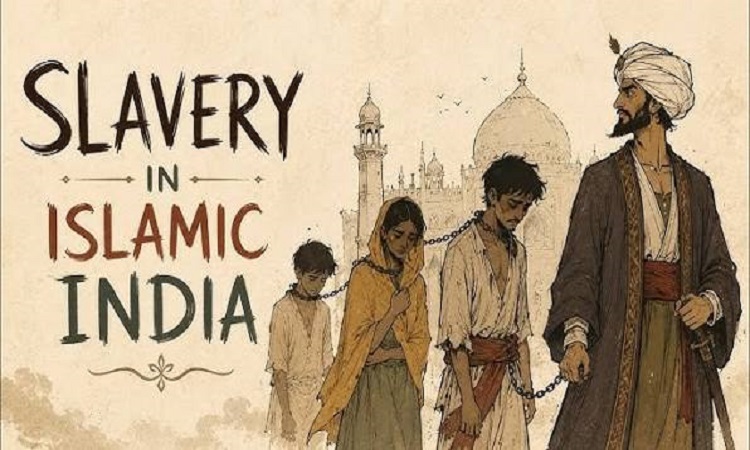
The whole world knows about the Western transatlantic slave trade or the Arab- Trans-Saharan, Red Sea, slave trade, but one that most don’t know or is intentionally ignored is the slave trade that took part during the Islamic period of India, first with invasions and then their rule of India.
But then why blame others when most Hindus have no idea either of their past or even present persecution of Hindus, or even the great resistance of our warriors to why Hinduism survived?
In a country of one billion Hindus known as India, where, apart from the Chhatrapati Shivaji Maharaj Museum created by François Gautier Museum on Shivaji, there are no museums or exhibitions on what took place against Hindus, where nearly 80 million were killed during 800 years of invasions and Islamic rule, and many taken as slaves, millions forced to convert, nothing on the Partition, where so many Hindus and Sikhs were killed, nothing about near to 3 million Hindus killed in 1971 during the creation of bangladesh but worse, hardly any temples, especially the major ones, have anything where they preach pseudo-Hinduism, meaning cowardice for cash handouts, which they also give in millions as jizya tax to the Indian government.
The millions of excuses we hear from pseudo Hindus, ‘we can’t do that because the government and police will close us down, or there is no Hindu ‘unity’, or worse, the past is past, as this is all maya, so don’t get attached to the world, or its all past karma so no need to get distracted when millions of Hindus are killed and raped blah blah blah….
Even Hindu writer Ram Swarup warned that modern gurus often promote an escapist spirituality. He critiqued preachers who use ancient concepts to justify ignoring the physical world, urging Hindus to embrace a worldly Dharma that fosters self-responsibility over escapism, blind following, and empty rituals. But he also mentions that the mindset started long before even Gandhi, who was just a product of this escapism. He says,
“Hindus fought Muslim invaders and locally established Muslim dynasties but neglected to study the religious and ideological motives of the invaders. Hindu learning or whatever remained of its earlier glory, followed the old grooves and its texts and speculations remained unmindful of the new phenomenon in their midst.
For example, even as late as the fourteenth century, when Malik Kafur was attacking areas in the far South, in the vicinity of the seat of Sri Ramanujacharya, the scholarly dissertations of disciples of the great teacher show no awareness of the fact.” – Ram Swarup
Social media influencers like Sai Deepak @jsaideepak or Anand Ranganathan @ARanganathan72 and others are doing a great job, but they need to point the finger towards where the biggest enemy of Hinduism that lies within, which is this Pseudo-Hinduism.
When Arab and Turkish armies marched into the Indian subcontinent, they didn’t just conquer territory; they captured hundreds of thousands of people, fueling a massive, state-sponsored machine of enslavement. This video dives into the dark and highly regulated world of the medieval Muslim slave system in India, where the institution was tightly interwoven with the laws of marriage, sale, and inheritance. Unlike ancient forms of servitude, this system was intertwined with religious mandate and holy war, transforming human captives into the very gears of the medieval state. We explore the bizarre paradox of the Mamluk “Slave Kings” of Delhi—men like Qutbuddin Aibak, Iltutmish, and Balban—who were purchased as property but wielded the sword to seize the throne, proving that loyalty was a luxury and conspiracy the rule.
We’ll look at the cold, hard economics of the slave markets, where rulers like Alauddin Khalji imposed strict price controls on human beings, trading them for horses or putting them to work in the tens of thousands to build massive monuments and fuel the state’s workshops (Karkhanas). The video also uncovers the grim reality of the sprawling royal harems and the horrific, systematic creation of tens of thousands of eunuch slaves to guard them—a practice so widespread that in places like Bengal, young boys were handed over to pay government revenue. Finally, uncover the forgotten story of how ordinary villagers fought back. Entire communities escaped into impenetrable jungles, choosing extreme poverty and isolation over chains and forced conversion—a defiant survival strategy that continues to shape India’s social and demographic fabric today. Follow and support Upw0rd
Source: Based on the historical research presented in The Muslim Slave System in Medieval India by K.S. Lal.Read The Full Book Here for Free –