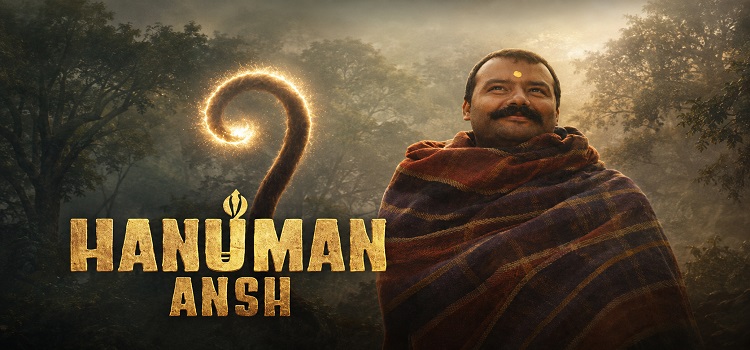

Hanuman Ansh: When the Ancient Calls Us Home
There are films we watch and forget before reaching home. Then there are films which seem to awaken something that was already waiting within us. Hanuman Ansh did this for me.
The film follows a grieving young boy who, after losing his mother, sets out seeking God in the hope of finding her again. His journey takes him through the sacred landscape of India and ultimately towards a profound discovery: God is not found merely by withdrawing from the world, but through bhakti, compassion and seva. The seeker eventually becomes the saint remembered as Neem Karoli Baba, with love, feeding others, remembrance of Ram and selfless service at the centre of his life.
It is a remarkably simple story. And perhaps that is its power.
For decades, much popular Hindi cinema has seemed uncomfortable allowing indigenous Hindu life simply to exist on screen without irony, caricature or apology. The pandit becomes comic, the guru suspect, ritual becomes superstition, while sophistication is frequently associated with moving away from inherited tradition. Whatever the intention of individual filmmakers, repeated cultural imagery of this kind can leave a Hindu audience absorbing a subtle message: to become modern, one must first become embarrassed by one’s ancestors.
Hanuman Ansh travels in the opposite direction.There is no cultural inferiority complex here. Nor does the film need enormous sets, celebrity actors or spectacular VFX to compensate for its subject. Reportedly produced for around ₹2 crore, it began almost unnoticed and subsequently became an extraordinary word-of-mouth success.
Its strength lies precisely in its lack of embarrassment. The Guru is allowed to be Guru. Bhakti is allowed to be bhakti. Hanuman is loved without qualification.
Seva is strength, humility is greatness, feeding another person is sacred, and devotion to Ram needs no sociological explanation before it may appear on screen.
That naturalness matters.Sanatana Dharma was never merely a collection of propositions one was required to believe. It became civilisation because Dharma entered ordinary life: how one greeted another, honoured parents and teachers, fed the stranger, treated animals, approached rivers and mountains, controlled one’s desires, performed one’s duty and understood service.
Modernity may obscure these samskaras, but it has not necessarily erased them.
Perhaps that helps explain why such a modest film could suddenly touch so many people. Its extraordinary theatrical rise was driven heavily by word of mouth after an initially tiny opening. Something in it was recognised.Jung might have called such recognition archetypal, an ancient image rising again from depths beneath the conscious personality.
Sanatana Dharma permits an even more expansive thought. Perhaps some things are familiar because they were never truly forgotten. A temple bell rings. A mantra is heard. Hanuman kneels before Rama. Shiva appears with Ganga flowing through His locks. A Guru feeds someone who is hungry.
And something within us quietly answers: I know this.
This is where Hanuman Ansh succeeds where enormous budgets sometimes fail. It does not merely place Hindu imagery upon a screen. It treats the Hindu sacred world as real from within itself.
In an age of endless scrolling, our attention is bought and sold through novelty. Another reel. Another outrage. Another face. Another desire.
Sacred art asks something entirely different of attention. It asks us to remember.
To remember that strength can bow before love. That knowledge without humility is incomplete. That feeding another being can be worship. That the Guru need not make us dependent, but can turn our gaze towards something greater than ourselves. And that Dharma does not belong exclusively to some vanished golden age.
The rishis may be ancient, but Dharma is present tense. Shiva still dances.Hanuman still serves. Ram is still remembered. And perhaps beneath the accumulated noise of modern India, those ancient samskaras are not dead at all. They are waiting to be awakened.
– Niraj