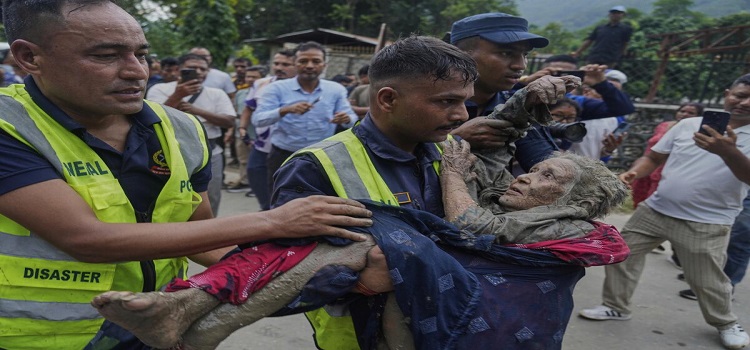
More than 4,216 people are missing, and at least 1,204 have died in Nepal so far.
What caused this Himalayan tsunami? Was it an earthquake or a glacier collapse? .
Maa Gambhiri, coordinator of Isha Sacred Walks, gives the first account of a group caught in the devastating Nepal flash flood near the border. She says 77 members of their group were at the immigration centre on the Chinese side, preparing to leave Tibet for Kathmandu, when the flood struck. The group includes pilgrims from 19 countries, including the US, UK, Canada, Australia, Lithuania and Germany. Gambhiri says they have not been able to establish contact with the 77 members or three volunteers on the Nepal side, and are awaiting official confirmation while reaching out to embassies and authorities. She says Sadhguru is safe with the larger group and that teams are providing support and updates to the families of those missing.
Nepal Floods to China’s Great Bend Dam: India’s Water Security Lessons Explained
Nepal’s devastating flash floods have once again exposed the raw vulnerability of the Himalayas. In Firstpost Spotlight, Daniela Laurel explains that while the disaster was caused by a glacial collapse, it has also drawn attention to another major development in the same fragile mountain system: China’s $167 billion Great Bend hydropower project on the Brahmaputra in Tibet. With China controlling the river’s upper reaches and India downstream, the project has raised concerns over water security, flood risks, seismic safety, transparency and strategic leverage. How much control will Beijing gain over the Brahmaputra? Could the dam be used for strategic flooding? And how is India responding? From the Nepal disaster to India’s proposed Siang project, Daniela Laurel explains the growing infrastructure and water-security contest along the Brahmaputra.
A group of 21 Tamil Nadu pilgrims had a narrow escape from Nepal’s devastating flash floods while travelling towards Kailash Mansarovar. The pilgrims were part of a 60-member group travelling in three buses when a massive surge of mud, water and debris hit near the border. They escaped by jumping from their bus and climbing a hill, but two buses carrying other pilgrims remain missing. The survivors were later rescued and reached Kathmandu airport, from where they are travelling to Delhi and then Chennai.
UK’s Nepalese community holds special prayers at South London Sanatan Mandir for missing loved ones
16 Members Of A South London Temple Missing
‘The helplessness at the moment is difficult’: The South London temple praying for their members, who are missing in the Himalayas.
Pray for Nepal. An Indian prays for Nepal. Every Indian stands with Nepal. Aum Namah Shivay!
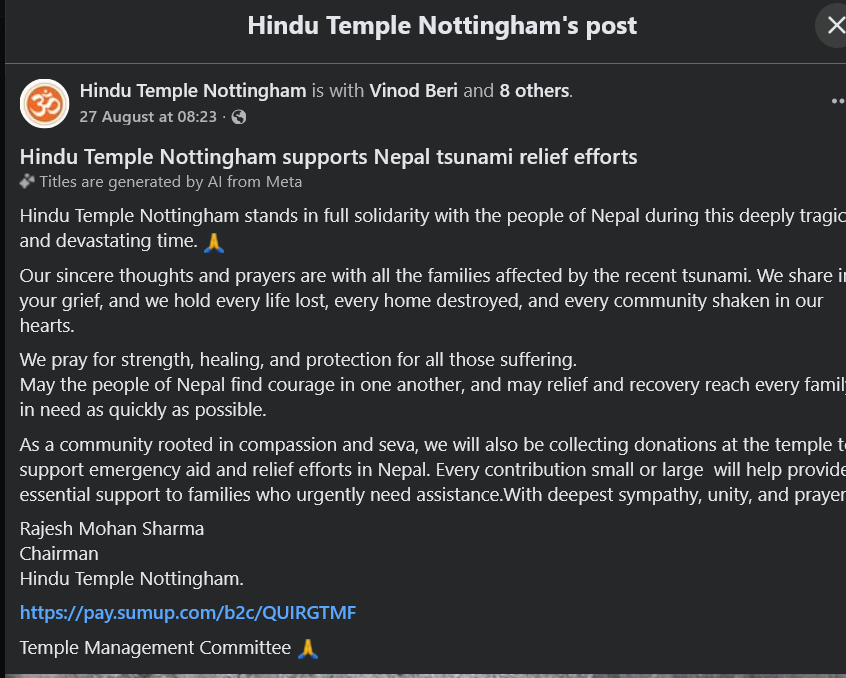
Hindu Temple Nottingham supports Nepal tsunami relief efforts
 Our sincere thoughts and prayers are with all the families affected by the recent tsunami. We share in your grief, and we hold every life lost, every home destroyed, and every community shaken in our hearts. We pray for strength, healing, and protection for all those suffering.
Hindu Temple Nottingham.
 We pray for the departed souls, for strength and comfort for the grieving families, and for the safety and recovery of everyone impacted by this tragedy.
Kurinchi Kumaran Temple will hold a special prayer on Monday, 31 August, for the people affected by the recent disaster in Nepal. We warmly invite our devotees and wider community to join us in prayer for those who have lost their lives, those affected and their families, and for the strength, safety and recovery of the people of Nepal.
May Lord Kurinchi Kumaran give strength and comfort to everyone affected.
We are deeply saddened by the devastation caused by the floods in Nepal and the suffering faced by countless families who have lost their loved ones, homes and livelihoods. At this difficult hour, we pray at the lotus feet of Sri Hari and Vayu Devaru for the sadgati of those who have lost their lives, for the speedy recovery of the injured, and for strength, courage and protection to all those affected by this calamity. We urge everyone to extend compassion and support to the affected families in whatever way possible. Dharma teaches us that in times of suffering, our prayers must be accompanied by karuṇā and seva. Even a small act of assistance can bring hope and relief to those passing through unimaginable hardship. Sri Matha has already taken multiple steps towards relief activities. May Sri Hari bless the people of Nepal with strength to overcome this tragedy, and may normalcy and peace be restored at the earliest. – Sri Uttaradi Math
A dramatic rescue has brought a rare moment of hope amid Nepal’s devastating floods. Two workers, identified as Sanjay and Kabir, have been rescued after spending nine days trapped deep inside a tunnel at the Trishuli hydropower project. With no food, water, light or adequate air, the two men survived as mud and debris blocked their escape. The rescue comes as catastrophic flash floods along Nepal’s Tibet border have killed more than 1,200 people and left thousands unaccounted for, including workers at the 60-megawatt hydropower project. Rescue teams from the Nepalese Army and Armed Police Force continue searching for survivors despite dangerous weather and further flooding risks. India has also sent additional rescue personnel and humanitarian aid to support relief efforts. Experts say the disaster also highlights a wider Himalayan challenge: shrinking glaciers, extreme events and the urgent need for better cross-border data sharing, early-warning systems and round-the-clock disaster coordination
I chanted mantras to give me hope, says tunnel survivor published at 13:54 4 September
The mechanical foreman, Sanjay Sah, says: “It was not right for me to run away… My responsibility was to save others.”
Sah says he chanted THE Hare Krishna Maha mantra.mantras while trapped in the darkness underground and managed to stay in contact with three or four other workers somewhere in the tunnel.
Sah was rescued with fellow survivor Kabir Maharjan, a mechanical supervisor.